Foundry Furnace Part 4 - Gasoline Burner
This video is an overview of the gasoline burner systems and a test firing of the foundry furnace:
Gasoline and Waste Oil Foundry Furnace from Jake von Slatt on Vimeo.
Jake von Slatt's gasoline and waste oil foundry, tour and test firing of the gasoline injector system.
For the blower assembly I used the design described in Dave Gingery's Building a Gas Fired Crucible Furnace. I used 18 Ga sheet metal from an old Compaq file server PC.
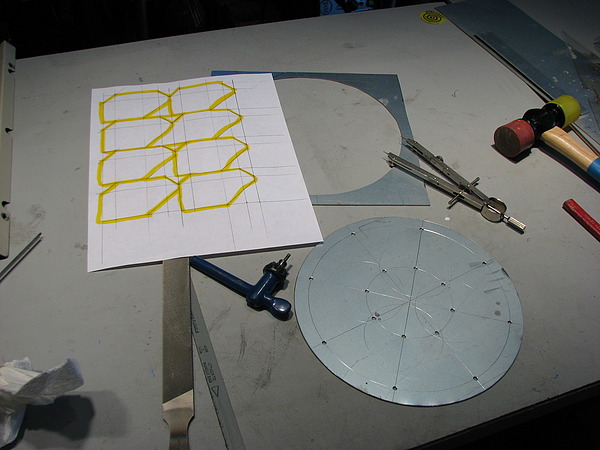
The blower wheel mounts to a belt driven buffer/grinding wheel mandrel. These are available at most hardware stores.
The fan enclosure or volute was cut form the same PC case and MIG welded.
I made a chassis for the fan and motor from some scavenged bed frame angle iron.
Dave Gingery's original blower was designed for propane, but I decided that I was going to build mine for gasoline. My main reason for this was that I wanted to gain some experience with gasoline burners in general for a future steam car project, but also because propane is boring. To atomize the the gasoline I used a BOSCH fuel injector from a BMW, I got these used off eBay for a few bucks each.
Fuel Injector Test for Gasoline Foundry Burner from Jake von Slatt on Vimeo.
The fuel injector was mounted behind a removable panel in the air-stream from the blower.
Here you'll also see a spark plug and a BBQ igniter, this idea totally didn't work.
I used the body of an old table lamp for my fuel tank. Inside the brass urn is a 12 volt fuel injection pump from a Nissan of some sort, the pressure line comes out the top and goes through a filter and the return line is fitted with a valve so I can adjust the fuel pressure.
Since I also need a way to adjust the amount of air I'm feeding into the furnace I needed some sort of throttle on the blower intake. I made this one with some more lamp parts, threaded rod and heavy wire.
At 30 PSI the fuel injector provides good atomization as well as A LOT of gasoline.
My original plan was to adjust the fuel flow by playing with the fuel pressure, however it turned out that at low pressures the fuel injector produces a stream rather than a nice mist and this does not work well at all when the furnace is cold. To address this I built a PWM controller using this circuit. With the PWM controller I can adjust the duty cycle of the injector while leaving the pressure at 30 PSI for good atomization.
It works pretty well.
To fire it up I start with the furnace open and the air flow at near zero. I turn on the fuel and light the burner, once it's burning well I close the furnace and let the interior heat up. After about 5 minutes I can turn the fuel up to full flow and adjust the air for a slight reducing atmosphere in the furnace.
At this rate the fuel tank empties in about twenty minutes, but the plan is to begin feeding waste oil as soon at the furnace is hot so the gallon tank for gasoline is plenty.
5 minutes in the furnace was enough to heat this bit of steel up to where I could pound it flat with a hammer, looks like I can use this for some limited forging too, though the configuration is not ideal.
.png)

Comments
Hot Metal!
Sweet! All this from Gingery's books! It's good to see that something CAN be made from these. I'm not implying that they aren't any good, just that these books have been around a long time and I haven't seen too many examples from them. Then there's the "Jake" factor where you have adapted the concept and made it work. It's the manner in which you arrive at solutions that make you the Maker that you are. Well done sir!
Nice Work, very impressive
I would change one thing though. It appears that you have used "RTV BLUE SILICONE" as a flexible sealant on you fuel tank top. Silicone is not good for gasoline exposure, it has a tendency to liquify. This shouldn't be a problem has long as your fuel doesn't slosh around inside the tank for any reason and come into contact with the sealant. otherwise I'd like to recommend the use of "COPPER COAT GASKET and THREAD SEALER" it's shellac based composite sealant, it stays tacky, but works great around all sorts of fuels. if that silicone dissolves into you fuel, it'll foul your pump, and wreck your injector.
Ah! Good point! it's what I
Ah! Good point! it's what I had at the moment I discovered the seal wasn't good enough.
Fuel puddling in the burner chamber
Make sure when shutting off the burner for the day that the injector does not stick open. If this happens, fuel puddles in the (hot) burner chamber. Usually, if it's gasoline, it will just flash off and burn, but if you're using a thicker fuel (waste oil, transmission fluid, etc.) it can vaporize without igniting. If you then try to relight the furnace, you'll lose some eyebrows. Trust me, this is the voice of experience talking. BTW, while most automotive fuel injection systems use ground-side switching for injectors, in this case it may be better to switch the hot (power) side. With ground-side switching, a short on the ground lead will cause the injector to energize continuously. An injector that uses hot-side switching will not energize continuously unless the hot side shorts to source power, something that is less likely to happen in this case.
PWM and Injectors...
Jake -
I'm just starting a flavor of the Gingery furnace, was planning on using propane but I like the idea of WVO. I'm curious about the choice of injector - are you planning on using the same(gasoline) one for the WVO? Seems like oil viscosity might be an issue without a preheater. Maybe a diesel injector?
Built myself a PWM last night - I'll spec the MOSFET after finding an injector. Off to watch eBay...
Looking forward to installment 5!
-paul
I don't actually have a good
I don't actually have a good answer for that. If you are starting with propane I'd go with the Lionel Labs solution:
http://www.backyardmetalcasting.com/oilburners09.html
The issue with my gasoline burner is that anything in the path of the gas droplets causes dripping of gas that pools in the burner tube. My plan is to construct a WVO injector of some sort that dumps fuel in right by the gas burners inlet.
SO impressive
Can't wait to see the finished results! I am wondering, too, what kind of extinguisher you keep on hand? Class B fire? Class K fire, with the introduction of the waste oil? What to do! What to do!
For forging, my gut becomes concerned about excessive firescale, but . . . since you have such minute control over your mixture, you can likely tune the atmosphere even more precisely than in a normal forge. Sure, it's less than ideal for forging, as you say, but I think it would do quite nicely for limited work. By sliding your long stock into that top hole for heating, you negate the need for a tool rest on its back end, hah! However the scrolls for that giant driveway gate or victorian chandelier will be tough to manage. :oP
Good show, sir.
Waste Oil feed
So what method are you going to use to feed waste oil into the furnace? If your an it through a filter, you could probably use a diesel injector on the same setup as your gasoline injector. If your going to allow a stream of oil by gravity run into it, I would run the metal supply tube around a hot point on the furnace to preheat it before it enters for better combustion.
I'll be using this
I'll be using this design: http://www.backyardmetalcasting.com/oilburners09.html