Jump to Navigation

Toyota Sienna Evaporative Canister (P0446) and SVS Valve Repair or Think Like a Maker

Rage drove me to it.  Our 2001 Toyota Sienna failed it's Massachusetts emissions test this year, the problem was with the evaporative emissions control system (code #P0446) so I dropped it at the dealer to be fixed. 

You see, several years ago I decided I had  enough frustration working on cars and decided to focus on more fun pursuits.

Several things have happened since then.  #1- I have a much better shop and more capable tools.  No rusted nut or bolt can resist the hot wrench (mechanic's slang for an oxy/acetylene cutting torch) !  and #2 - I've become a radical Makepunk. 

. . .

So when the dealer called me with a quote of $720 my response was "$720 to replace a part that is essentially just a paint can full of charcoal! You got to be F'ing kidding me!"  Bastards!

So I got me a code reader from Scantool and did some research on common failures.
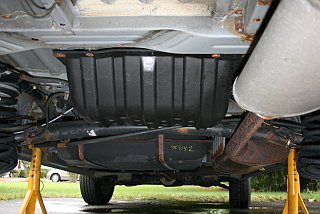
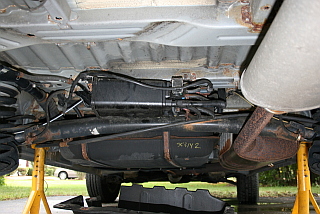
evaporative charcoal canister on a 2001 Toyota Sienna is located behind the gas tank under the car evaporative charcoal canister on a 2001 Toyota Sienna is located under a plastic shield

The most common failures seemed to be a saturated charcoal canister, a leaking canister, and the SVS purge valve solenoid.  The evaporative emissions charcoal canister in my 2001 Toyota Sienna is located under the plastic shield between the gas tank and the spare tire.
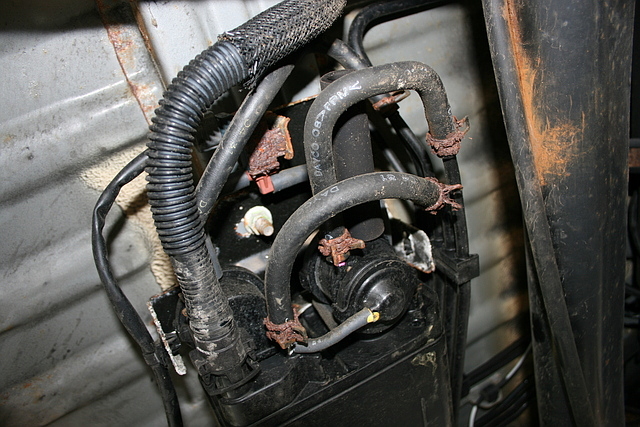
evaporative charcoal canister on a 2001 Toyota Sienna hose connections

I unscrewed the shield and took a good picture of the hoses so I would have a guide when it can time to re-install.
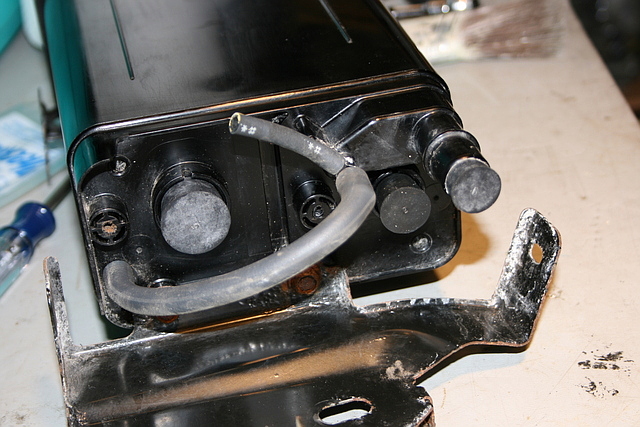
pressure testing evaporative charcoal canister on a 2001 Toyota Sienna

There was no liquid gasoline in the system and only a slight smell of gas from the canister - it was clearly not saturated.  If it had been I was planning to drain it and then gently bake it in a very well ventilated area until dry.

Since one of the possible failures that would cause the ODB-II code P0446 the scan tool showed was a leaking charcoal canister I decide to pressure test it.  The local hardware store provided a selection of rubber stoppers to plug it's orifices and I blew into a tube until I could see the sides of the canister bulge - way more pressure then it would ever see in operation - no leaks.


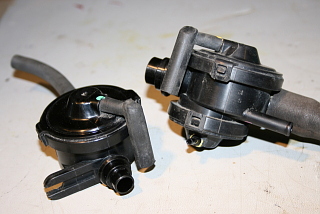
vacuum valves from evaporative charcoal canister on a 2001 Toyota Sienna


I was going to disassemble and inspect the insides of these vacuum valves to make sure they were working but Toyota has glued the snap-tabs in place, the bastards! 

However blowing in to their various openings resulted in satisfying pops and appropriate resistance that made me fairly confident that they were not stuck or damaged.
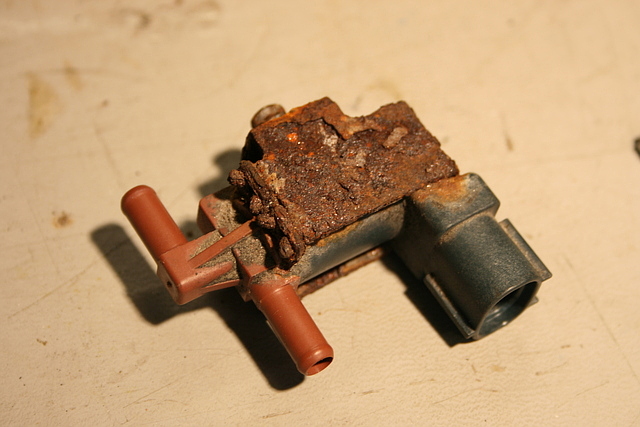
2001 Toyota Sienna svs valve

This is the SVS Valve and it is suppose to be closed until energized, mine was stuck open.  I took a short trip to the local auto parts store but they had no such item.
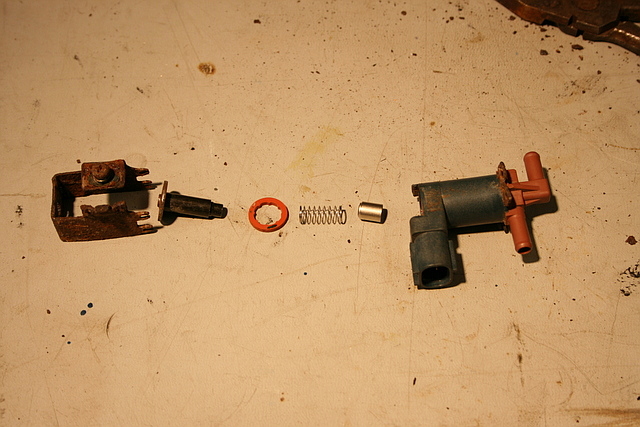
2001 Toyota Sienna svs valve repair

There was no way I was going back to the dealer for the part so I decided to see if I could fix it.  It was pretty rusty but I was able to bend the tabs back and disassemble it.  The silver plunger on the right was indeed sticking in the barrel.  I cleaned everything thoroughly but is still stuck.  The next step was to take a piece of thin-wall brass tube that was a little larger than the bore and push it in.  That did  it, the plunger moved smoothly and when re-assembled the valve functioned flawlessly.  I suspected that the plastic in the valve body had swollen ever so slightly due to years of exposure to gasoline fumes.

The moral is; don't think like a mechanic who replaces assemblies, think like a Maker and seek the root case!
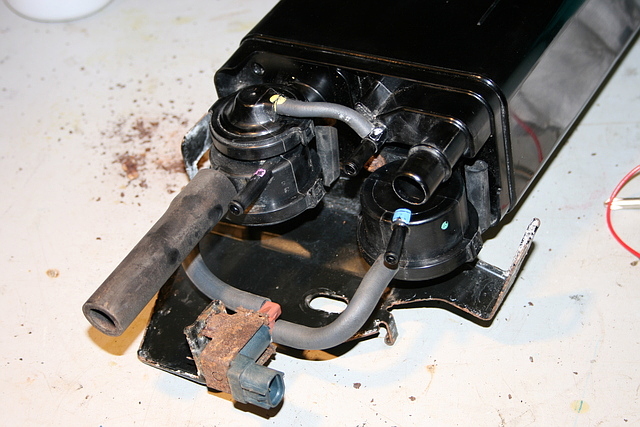
Everything went back in the car and I used the scan tool to clear the P0446 code.  The vehicle now needs to go through a few driving cycles before the ECU sets the 'readiness' code and it can be re-tested.  I did have to spend $98.95 for the scantool, but its time to start fixing my own cars again and they are mostly ODB-II so I needed a scanner anyway and its still a lot less then the $720 the dealer quoted.

Articles:

Comments

Huzzah! Whatever can be created by the mind of Man, can be repaired by Man and/or Woman. Congratulations on defeating the corporate mentality of extracting more profit on auto repairs than they made off of selling the car in the first place. Logan

Jake your illustrated SVS valve repair article was awesome! I had the P0446 light on, reset it, only to have it come back a week or so later. I found your article and got under my 02 Sienna. After wrestling the very rusted nuts off of the plastic cover, I checked all the hoses and everything looked pretty good. I pulled one of the hoses off the SVS valve and heard the canister immediately vent out all the contents for a good 20-30 seconds. Well, I now knew the canister wasn't leaking. I immediately suspected the valve and took it apart like you did. It was sticking closed. I found some corrosion on the piston, but cleaning that up didn't help, it was still sticky. I followed your lead and took a piece of copper tubing - flared the end enough to scrape the insides of the valve bore, ran that through a bunch of times. Ran some 320 sandpaper down the bore and it seemed to be running pretty free. I put it all back together and reset the light again. I'm hoping that it won't come back on. If it does, I found a canister assembly online for about $250. I hope it doesn't come to that. It sucks that you can't buy the valve without the whole canister. For want of a $12 valve, I gotta spend $250? That's BS. Anyway, I wanted to just thank you for taking the time to document your work, it was a HUGE help to me!

- Matt

Jake's perseverence saved me a bundle. I had read dozens of webpages and even followed Toyota's troubleshooting procedure in a pdf specific to my model (an '00 Echo with 165k miles). For two months I disconnected, blew through, and sent 12V to the solenoid valves on the canister and by the air filter. I even pushed at the rollover trap at the opening to the gas tank itself. Still had 6 different gas station pumps shut off every 3 seconds on me.

My mechanic had offered to do a "smoke test" through the system. By the time I'd given up and brought my car to him, he was ill and a guy covering for him was too busy to take the job. I told him I'd pulled the vapor canister, shaken and sniffed it for raw gas, blown through all its ports, heard a satisfying ka-chunk on sending 12V to the solenoid. He stopped me there and said the ka-chunk when it's off the vehicle doesn't mean it's working when "under pressure" in an active vapor recovery system. He suggested I pull a different hose from the canister and try to fill up again. I didn't bother. I realized it was a different larger hose than I'd pulled the previous time I'd tried this test. It's the larger hose leading to the solenoid Jake had dismantled. Of course! So instead of dismantling it like Jake did (its brackets looked rusty and I feared breaking them in prying it off, opening and cleaning it, I crawled under the car, removed the two hoses leading to the solenoid, and simply sprayed SILICONE SPRAY through a long straw through them, reaching as far in as the straw would go. Then I turned the ignition key back and forth on the last click to work the silicone into the valve.

SUCCESS! I've filled the gas tank three times now -- from one-quarter empty, to half empty, to almost totally empty, and not one click of the gas pump!

Jake's right -- the solenoid valve gets sticky. Whether you need to open and clean it depends on its condition. I do believe that other lubricants (WD40, carb cleaner, etc.) might mess with the 02 sensor or, more realistically, degrade the rubber washer on the solenoid itself, so I used silicone spray which doesn't impair rubber. Good luck to anyone who tries spraying first, and better luck to those who try Jake's method which may be necessary after all. Most importantly, don't pay Toyota $300 for a whole new vapor canister just to fix a sticky valve which they don't sell separately.

Another satisfied reader, Jake. 2001 Avalon with P0440, P0441, and P0446. Everything else checked good, so I pulled the VSV you show. The piston was actually a little rusty and siezed pretty tight. I drilled a 3/64 hole in the top of the brown plastic body and then used the drill bit to press the piston out from the top. Sealed up the hole with a little epoxy. I also had to flare a piece of 1/4 copper tube to clean out the inside of the cylinder. Everything's moving smoothly. I just checked, the evap system shows OK on the scanner, and still no error code.

I was also having a P0330 knock sensor error--whether this error can be caused by the evap error, I can't say, but it's OK now. The only other thing I did was put a can of Sea Foam fuel system cleaner in the tank, since I had seen that as a fix elsewhere.

Thanks for your help with this.

I had taken my 01 Avalon to the shop due to upcoming emissions test, with a CEL of 0446. $295.00 later i thought i was good to go. Then, 45 days (about 850 miles since paid repair) later light and same code returned. Move over!! With your instructions, i have this. Thanks for the time you took to allow others the money saving fix!

Did they replace any parts for $295? My shop wanted to replace the canister, but my canister seems okay. The VSV looked dirty, wiped off clean and tested okay.

i was charged $295, for parts and labor, the part they replaced was the aft o2 sensor....

My 2003 sienna has the same hose hook up to the cannister, but the Toyota Service Manual has lines is different. The Purge port goes to the VSV for the EVAP (manifold) and the air inlet port goes to the CCV on the air filter housing.

Are your lines according the the service manual or like mine? Does it matter?

I have the codes P04441, P0442 and P0446 after 4 days. It will not give a complete OBDII before the codes, so won't pass the CA smog test. I can't trigger it with the SCANNER send EVAP test to computer. A year ago, it was giving a very small leak only.

TSB EG013-03, revise sep 29, 2003 has testing of the CCV for P0440, P0441 and P0446 codes. The CCV is not holding a vacuum when powered by a 9V battery. The canister VSV is holding the pressure and seems to work.

Dorman makes replacement VSV valves for the canister, but the one I got didn't hold pressure. Good thing I tested it before installing.

Any suggestions? Running out of time to pass the Smog test, registration $ with SMOG cert. are due.

Also if the canister is cracked has anybody tried plastic welding?

parts and labor, with the parts replaced being the aft o2 sensor, 850 miles later i am doing it myself...

After 4 days post replacing with a new CCV (on the air filter housing), the same P0441, P0442 and P0446 codes with pending P0441 and P0442. When to another mechanic who used a Snap-On scanner that may have method to activate the VSV's and said need new Genuine Toyota Gas cap was needed, then after 4 days and I/M status still had Cat Conv and EVAP incomplete, I ran the "cold readiness monitor drive pattern" #6 in EG003-02 to activate the EVAP test. The drive patterns used to trigger some of the tests are very abnormal driving patterns. Codes came back during the idle cycle. Brought back to mechanic who then said the filler hose was loose. He doesn't know what to do if the codes comes back. The codes came back just before the SMOG test.

The CCV tested good 3 weeks ago, but then failed 2 weeks ago. Now tried rebuilding the CCV. The rubber seal was dirty and preventing the sealing. I couldn't crimp back the metal back to close the valve. The valve activated to close when voltage is applied regardless of the polarity applied (doesn't matter which direction the battery is connected). How does that work? Has anybody tried to fix the CCV by vacuuming detergent, water, and finally clean air to dry the valve?

Are your rebuilt charcoal canister still working after 7 years? What's the expected life of the canister?

Canister's VSV, 90910-12264 is now available at Toyota for $55 list or $40 discounted mail order or $120 less 10% at my local Toyota. Just need to get Toyota to sell the vacuum activated valves.

All I can think of is an transient problem (bad connection, dirt in valve) or bad computer. Anybody else have the problem of the 3 codes and have everything test okay? My Autel scan tool EVAP command doesn't trigger a code. The 10 sec at 3000 rpm will cause the codes and command test has:
Test $02 Data
ID:....................... 01.........02........03........04
module:................$10........$10......$10......$10
measured:..............4A..........36.......93....... 0
Max:.......................---..........---......17........FF ?
Min:........................62..........40.......---........---
STS:.....................failed......failed....failed......on

Anybody know what these codes/test mean?

I gave up and brought the car to a test and repair shop. No leaks with the smoke machine, all valves including canister vacuum valves works. Vacuum profile okay. No fix. Diagnosis $100. He arranged for a "test only station" smog test for $50. The car passed.