Jump to Navigation

Moving a Bridgeport Milling Machine - Recreational Rigging

One of my goals for this year is to add some real machining capabilities to my shop. I've been in the market for a milling machine since the beginning of the year and when I saw a Bridgeport series II CNC mill pop up on Craiglist for $1000 I decided to jump at it.

This is an older CNC mill that is in great shape as far as the iron is concerned but, according to the seller, had exhibited some flakiness with the controller after being moved. These things are pretty primitive TTL logic cards feeding power Darlington output transistor that drive stepper motors so I have no doubt that I will be able to fix what ever may be amiss--most likely the boards just need to be re-seated.

If I have too much difficultly resurrecting the BOSS controller I will very likely convert the machine to use the EMC2 Linux based controller. In fact, I will probably convert regardless, but I need to study the pros and cons first.

how to move a milling machine

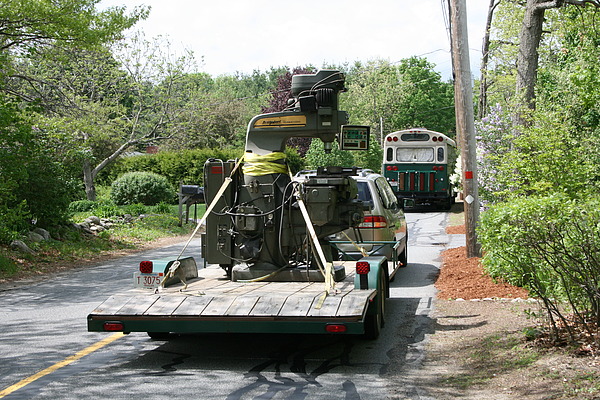
The machine itself weighs in at about 3500Lbs. Each of these forklifts is rated at 3000Lbs. Some creative positioning and the addition of a strap finally got the machine high enough so that I could back my flatbed trailer under it. 

how to move a milling machine

I was a bit nervous about the prospect of using two forklifts in concert. All of us here are folks who know how to do things, but the fellow on the fork truck to the left is a man who knows how to get shit done and he directed the action.

how to move a milling machine

Once on the trailer I used a come-along to skid the machine up over the axles. My trailer has electric brakes and set at %60 they did a nice job of stopping the rig. This is important because the milling machine weighs about the same as my Toyota Sienna. The Sienna huffed and puffed up hills but had no real issues hauling the rig the 6 miles to The Workshop.

Moving a Bridgeport Series II CNC Mill

Had to pull the bus out so I could store the machine out back while I went to The Steampunk World's Fair and Maker Faire the following two weekends.
Moving a Bridgeport Series II CNC Mill

The weekend after Maker Faire I started by constructing and erecting a gantry crane to unload the machine. The crane used (2) 2x10x12' and (2) 2x6x12' pieces of lumber for each leg. The 2bys were screwed together with 3" drywall screws every couple of feet.

Moving a Bridgeport Series II CNC Mill

I cut the flange off of an I-beam with my Oxy/Acetylene torch so I could sandwich it between the boards. 

Moving a Bridgeport Series II CNC Mill

Then lifted it into place with a come-along.

Moving a Bridgeport Series II CNC Mill

Next step: back the trailer under the crane.

Moving a Bridgeport Series II CNC Mill

Up we go!

Moving a Bridgeport Series II CNC Mill

Soft landing.

Moving a Bridgeport Series II CNC Mill

The machine is too tall to fit through the garage door so I un-bolted the head.

Moving a Bridgeport Series II CNC Mill

Finally, I lifted the machine and slide several lengths of 1/2" black iron pipe under it and dragged it into the garage. If I had to do it again I would build the crane as close to the door as possible because the most difficult part of the job was getting the machine to move over the sun heated and softened asphalt driveway. 

Moving a Bridgeport Series II CNC Mill

Next weekend I will clear a wall for the machine and place it in it's final spot. Then I need to buy or build a rotary phase converter to convert my household 240 VAC to the three phase power this machine needs.  

Part II - Converting the Bridgeport Series II to Gecko Drives & Mach3

Comments

Wow. The weight of so much potential, sitting in a innocent-looking residential garage.

Have you considered getting a VFD?
If you Google for Bridgeport "single-phase", lots of people recommend getting a solid-state variable frequency drive (VFD) instead of a rotary phase converter.

I think they're mainly for manual units, the CNC has a bunch of electronics and while they could be re-powered, making a rotary phase converter from a 5-10 horse three phase motor will be easier.

You may find the CNC side of the system uses a single phase. The Three phase 220v was used to permit lower gauge (higher number) wire to carry current, and to produce three power pulses per rotation of the motor. I used a TECO VFD for the 1 HP motor in my South Bend Lathe. It sure is nice to have infinitely variable speeds instead of six. What's the motor rated at?

That said, I've seen a number of phase converters which were nothing more than a single phase motor, a pulley and belt arrangement, and a surplus three phase motor. IMHO, it lacks a certain polish, but it does accomplish the task.

A rotary phase converter is basically just a three phase motor and some caps. There's lots of good resources online for building them like: http://www.metalwebnews.com/howto/ph-conv/ph-conv.html .

Hi Jake, I may be a bit late with this comment, but these days if you can manage it, using an invertor AC motor controller is generally better than either a static (capacitors and inductors) or rotary (same but with an idler motor). It can be a bit more involved using an AC motor controller with a mill, but the results are also much better since you get a fully variable speed machine. The difficulty comes with machines that have multiple motors. A mill will often have separate motors for power feeds and for coolant pumps. They have to be separated so they are not being run from the AC motor controller...usually not a problem since they are usually single phase motors, generally only the main drive needs three phase, and that is the one you want the controller on. Of course one advantage is that you can often run an AC motor controller from a single phase supply...this depends on getting the right controller, but is very useful for amateurs who do not have three phase in their houses. Anyway, a Bridgeport is a fine machine and you should get some good work out of it. Although I would have to say that a big shaper, or even better a planer, would be far more in keeping with the steam punk theme. I have four shapers, ranging from 6 inch through 10", 14 inch, and 18". There are of course things that a vertical mill can do that a shaper cannot, so I have a Chinese mill as well. The 14 inch shaper has the old flat belt drive system as seen in 19th century workshops, with fast and loose pulleys and a four step pulley for the speed change. I have not set that up yet, I may donate it to our local technology museum where we are setting up a belt drive workshop. We also have an 1860's beam beam pumping engine which we fully restored to steam a few years back. This is all at MOTAT in Auckland New Zealand.

I'm not sure if I regards myself as a Steampunk or not, I'm probably more of a traditional steam hobbyist except that I really love the anachronistic and creative aspects of a lot of the steampunk work. (I grew up reading Verne and Wells.) I tend to approve most of all of things that work at least to some degree as intended, so I sympathise entirely with the sentiments of the "stick a gear on it and call it steam punk" video. On the other hand, I am perfectly happy to go along with anachronistic features, as for example any of the computers built into Steampunk case must be. I'm building a 30 foot long by six foot beam steam launch. It has a compound twin engine, built from published plans which I modified a bit...piston valves on both cylinders instead of a slide on the low pressure for instance. The boiler is water tube and will be oil fired, using waste cooking oil. Unlike the biodiesel guys I will be able to burn this as is, just straining the worst of the food debris out to avoid clogging the burner. The hull is modelled on Late Victorian/ Edwardian Windermere boats and Thames inspection launches, except for being about half the length. The actual structure is modern, being strip plank cedar with glass inside and out, but of course with paint on looks like an original. The deck is planked to look like and original , but the planking is very thin and the actual support is a foam core with thin plywood either side. All looks original, but much more practical.There will be plenty of anachronistic features, eg imitation antique oil lamps with modern high power LEDs inside. The boat is big enough to allow my wife and I to overnight in it but can be trailered to suitable lakes and rivers. I have been working on it ten years, it may be ready to launch in a year or two.

regards
mjolnir

this is great Jake can't wait to see the out come and what you do with it

Somewhere around here, I have a disk image of the drive of the Bridgeport CNC machine I used at one shop. It had a 386 PC running Win 3.1 on it. I think the total size of the software, along with the various program files comes to around 10 megs or so. If you're interested in it, drop me a note and I'll send it to you.

Nice job moving that Bridgeport.

I've gone through this myself a couple of years ago. I was given a Bridgeport similar to yours, but there was a catch. I had to get the machine out of the machine shop it was in right now, because some new equipment was about to be delivered to take its place. And, of course, there was no one available to help.

I arrived with my pickup, open motorcycle trailer, a half dozen lengths of 1" black pipe, pinch bar, come along, and some blocks of scrap wood.

I used the pinch bar to raise the foot of the machine and, while one end was up, kicked a length of pipe underneath. Repeated this on the other side. Then, with the pinch bar, it was easy to roll the Bridgeport out of the building.

To get it onto the trailer, I alternately raised the machine from side to side, using small lengths of 2x and 4x as cribbing. Once the machine was higher than the bed of the trailer and overhanging it a bit, I used the come along to drag it right onto the trailer. I strapped it down to the trailer (carefully: these machines are a bit top heavy - you can adjust the knee and the table to get the balance just right -- this also makes it easy to change the CG of the machine as you are horsing it around).

Got it home and used the come along to drag the machine almost off the trailer. Again, used the pinch bar and blocking to raise it up to the point where I could withdraw the trailer.

Now, using the pinchbar, I let the machine down off the cribbing until it again sat on the iron pipes. From there I used the pinchbar and the comealong to persuade the machine into its final resting place in my shop.

Took four hours and I did it almost all of it myself - my kids did help me ratchet the comealong as I was unloading, and that sped things up.

I love rigging and moving heavy items in general. It is quite satisfying to move something using the most basic tools and techniques (it's all leverage).

You will really enjoy that mill. Many say that a lathe is the most useful shop tool, and while lathes are quite wonderful, I find a milling machine to be incredibly handy for us fabricators.

Agreed! and a CNC mill does round stuff nearly as well as a lathe.

I probably could have managed to get the machine off of the trailer using cribbing but the driveway in front of my garage is on a slope and I felt more comfortable building the gantry. I wish the wife would let me leave it up!  wink

You raise a good point: a CNC mill can lathe, but a CNC lathe can't mill. :)

That is indeed a nice gantry and you should be able to knock it down so that you can reuse it as needed.

BTW the way you braced your gantry against the building is somewhat reminiscent of a gin pole - a portable, temporary 'crane' that needs but one girder. You can rig a gin pole using vehicles as one or more of the anchors needed for the three guys.

I'm still fairly new into Engineering (Freshman at UNR next spring), but I've got a little experience with jewelry and CAD. Is this a milling machine that carves and grinds for you, or provides the power while you manipulate the piece with your hands? Either way, nice steal!

With a lathe, the work moves and the cutting tool is stationary.

With a mill, the work is stationary and the cutter moves.

Either can be controlled by hand (feeding the tool against the work) or by automated control. Jake's mill has automated controls, which can make it faster to use and also eases repeatability.

Non-automated machines are easier and cheaper to find, since numerically-controlled versions are cheap enough to be commonplace -- no production shop wants to be tied to manual machines. The numerical machines have been out long enough now that they themselves are being replaced with newer ones, and this could be part of the reason behind Jake's score.

Well, technically; with a lathe the work turns and the cutter moves into it and on a mill the cutter turns and the work moves into it. I'm just picking nits, sorry.

That's quite the thing you got there! I guess I was thinking of a manual mill when you were talking about expanding your machining capabilities, but I guess chance rules. Even if you can get it to work as is, upgrading the controls will give you something more useful; better computer interface and so on. I've been itching to put an extruder onto my CNC to see if I could use it as a printer. Just having a 3-axis volume that you control via computer is huge, but adding the horsepower/rigidity factor of the Bridgeport opens up all kinds of possibilities. Looking forward to more!

What are you thinking about design/toolpath generation software?

No offense, but, I hardly envy you having to move that beast. Once it's cleaned up it should look awesome, but hopefully it functions really nicely too

We have a similar vintage Bridgeport at my place of employment. I ran it for a while with the original stepper motors. While it still ran using the original control, the program length was very limited. It had the original paper tape drive. The memory capacity was expressed in the equivalent number of paper tape feet! We had the machine schematics so I was able to give pulse inputs to several pins on one of the boards using EMC. That got rid of the programming limitations. It was still a bit cumbersome, and for some reason that I never understood the maximum rapid velocity I could get without losing steps was 48 inches per minute compared to the original 120 ipm. We ended up changing to a Centroid control with servo motors. After that we could get some work done. Your machine may be new enough to be able to "drip feed" programs to it using a "DNC" program. Do some searching on the web (as I am sure you already have) and you should find some relevant info. Our machine was a BOSS 1, and as I recall it lacked handshaking capability, so I was limited in the length of program that I could send to it through the RS232 interface. The darlington transistors, ah yes. The spare parts box had several spares. Good thing, because I ending up replacing a few.

The seller told me that this machine generally was run DNC, this makes sense to me because, despite it's age, the keypad and controls are in excellent shape.  I do like the idea of a servo retro-fit with EMC2 though, but I plan to run the original controller for now.

I was wondering what a "rotary phase converter" was; a motor generator. I use them for DC/AC, AC/DC on the ship.

Industrial Beauty in its purest form, that thing is making me DROOL.

and the crane ain't bad-looking either

wish i had the space to put some machines like that beast in..

sofar i only have about 18 m2 for my projects, but ey ;).. like with bonsai trees,... small can be beautifull to :P

greets from the Netherlands...

Richard