Cheap and Easy Fabric Dye From Natural Sources
Libby Bulloff — Fri, 02/26/2010 - 14:55
One of the ways I upcycle old, worn garments is to dye them. Stained, stretched-out beaters, ratty petticoats, and once-white tuxedo shirts with dingy collars enshroud themselves in new life when dropped into a steaming bucket of color. As my best friend is a pedigreed textiles artist, I've spent many a night in a professional dye lab, using bromine and other harsh chemicals to deposit tint onto wool, but I feel that the most satisfying way to dye fabric is to use what is essentially garbage. I speak of items you're probably going to toss or compost anyway, like yellow onion skins, beet tops, yesterday's Earl Grey bag, or that rusting tin of turmeric you bought eons ago for Indian cooking (but instead forgot in the back of the cabinet). Natural dye has been used to color fabric for 4,500 years, and was even popular amongst German soldiers in World War II due to broken trade routes.1
The basic alchemy for kitchen dyeing is as follows. You'll need one or more of the previously mentioned food items (I save lots of onion skins or old tea bags in Tupperware as I use them), a big pot that's heat-safe, water, a stirring implement, a stove, and a light-colored garment for modification. Starting with something about which you're not obsessively passionate, like a handkerchief or an old undershirt, can be an excellent failsafe if you're concerned about making a mistake (though I thoroughly encourage "mistakes"--that's how you get the coolest clothes!). You will also want to stick with garments that are mostly of natural fibers like wool or cotton--synthetics don't always take too kindly to natural dye.
It's important to rinse out your fabric prior to dyeing in order to release dirt particles hanging in the fibers, and to help open their cuticle. I always run my clothing items through a hot bath with a concentrated detergent called Synthrapol (Dharma Trading also makes a Professional Textile Detergent that is more earth-friendly, but I haven't tried it yet). Synthrapol or its ilk is important if you want an even and consistent color, and best of all: it's super inexpensive, and you only need a capful to do a small tub/sink of clothes.
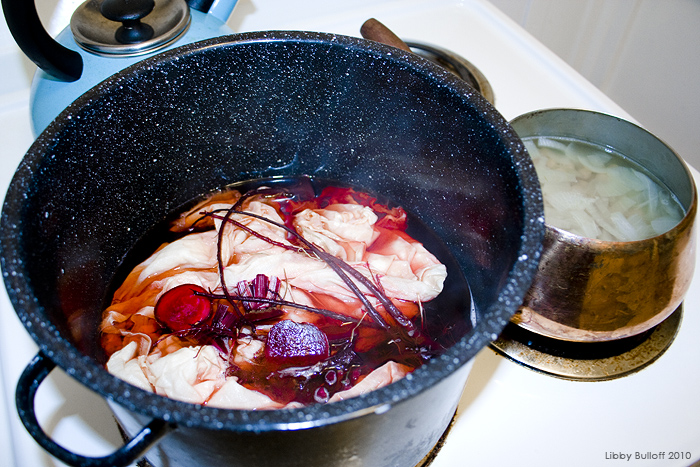
Some naturally brilliant vegetables like beets stain your hands and the Formica, but oddly enough, won't leave much color on fabric without a mordant. A mordant essentially opens up the fabric and allows the dye to cut into the fibers, giving it permanence. If you decide you want to use beet bits to make dye, you'll likely want to stick with wool fabric of a light color, and you'll need to soak the cloth in a mixture of half vinegar, half water before tossing it in the dye bath.
After rinsing our your clothing items, prepare your pot on the stove with enough water to cover your fabric. Begin to raise its temperature, and then add your onion skins/turmeric/old tea leaves/etc. Obviously, the more skins/spices/tea/etc. you toss in, the more brilliant the color, and don't fear mixing items. After the water heats, toss in your garment and agitate with your stirring implement so that the fabric gets evenly covered. You'll want to bring the temperature up to just under a boil, and let the fabric simmer for an hour, watching it carefully and poking at it from time to time to make sure the stain is consistent. The, shut off the heat, and let the garment cool in the pot overnight (I find that this really helps the fabric inhale any color remaining in the pot).
Rinse the clothes out the next morning in cold water (it helps set the color), brushing off any spice residue or stray tea leaves. Hang dry, and iron if you see fit.
You can try experimenting with gradated dip-dyeing techniques, tie-dye, or shibori. I just love the sepia tone that old tea leaves give to my once snow-white cotton corset, and the gorgeous monk-friendly shade of saffron that onions and turmeric lend to my hand-made tattery muslin collar.
If you have any tips regarding natural dyeing, do leave them in the comments! Thank you.
1 Info obtained from The Ecologist.
Search
Projects
LCD Monitor
Light Switch Plates
Wimshurst Machine
MAC Mini Mod
Altoids Tin Etching
Lightbox
Guitar Amp
Lyra's Lamp
Shop Respirator
Etching Brass
Flash Diffuser
Bus Conversion
All-in-One PC
Motorbike
Etch Machining
iPod Etch
Headphone Mod
Steampunk Strat
Telegraph Build
Steampunk Car
Trilobite Etch
Kerosene Lamps
Trailer
Contact
- Twitter: Jake | Meredith
- Jake is on Facebook
- More of Jake's projects: www.vonslatt.com
- Meredith's Blog: ladycartoonist.com/
- Jake's Shared Google Reader Items
- Email Jake: jake@vonslatt.com
- Email Meredith: satiredun@gmail.com

Designs by Jake von Slatt on this site are licensed under a Creative Commons Attribution, Noncommercial, Share Alike 3.0 United States License.
Permissions beyond the scope of this license may be available here.
Your email will never be divulged and we will only make an announcement when there is a genuinely interesting new thing.
Login
Subscribe
Your email will never be divulged and we will only make an announcement when there is a genuinely interesting new thing.


discount shop
bestshop — Fri, 06/25/2010 - 07:58Clothes for every occasion and all information about clothing, dresses, skirts, jeans, pants, sweaters and other Accessoiries.
Visit:
edc shirt
look!!
lxy — Wed, 06/02/2010 - 22:30prom dresses
natural dyes are fun...if you
lady cordelia d... — Sun, 05/23/2010 - 10:52natural dyes are fun...if you have some scraps of white or ivory coloured fabric (strongly suggested before dying the whole garnment if you aren't sure what color soemthing is going to come out) i suggest going on a walk (or raiding the vegetable bin) and making note of each sample of bark, lichen, leaf and root you pick as dye...many common roots, leaves and bark, even flower heads can be used as dye, and may react differently with different fabrics (also using things like liquid from a jar in which you soak some old nails creates a mordant which can change how the dye stuff reacts with the fabric and enhance and even change the colour). so many variations of browns, yellows, pinks, coral, green, grey and even purple can be achieved with natural dyes that you can find in your kitchen, yard or local park.
look!!
lxy — Wed, 06/02/2010 - 22:27prom dresses
Green dye
banshee6987 — Sat, 03/27/2010 - 21:09I have found that nettles tea leaves a beautiful pale mossy-green dye behind once done with the drink! It is fun to experiment with different herbal teas to see just what colors you come up with. Also, Horsetail tea is another good source for a darker green.
"Dirty" shirts
businessgypsy — Tue, 03/02/2010 - 13:39Depending on where you live, your dye may be as cheap as dirt! In any area with unimproved roads that look red, iron oxide in the clay soils make an excellent Sienna dye. Ochre is also found in clay soils, so a rich yellowish gold is also on your fashionably dirty laundry list.
There's some tips for using dirt for dye here: http://www.wtamu.edu/~crobinson/drdirt/dirt_shirt_act.html
Pre treatment with soda ash (anhydrous sodium bicarbonate), a strong base, will help the fibers receive pigment. If you want to get real basic, use fireplace ashes - or Arm and Hammer brand "Super Washing Soda", although it is a bit more hydrated than optimum. The pigment can be 'fixed' with acid - which you have in your house in as 5% acetic acid (vinegar).
Aren't you glad you stayed in science class while the jocks were off playing war games?
dye
izzitnot — Mon, 03/01/2010 - 04:50Any advice on washing natural dyes? (Yes, I know to ideally handwash cold & dry flat. But at some point all my clothes will become drip-dry "delicates", & I'm lazy...) I know thru accidental spill that Tide w/ enzymes takes out tumeric, for example...
One thing my mother used to do was to accentuate RIT dye (hey, it's all there was) with natural ingredients to make the color richer with no effort. To an insipid brown powder dye she added Hershey's cocoa, resulting in a rich hue.
Don't dismiss artificial clothes too fast. When we dyed a white polyester Edwardian-like shirt navy, it did take days of repeated doses to get it darker than a chambray hue. However, the embroidery was done in cotton, and it suddenly stood out against the shirt along with the lace and buttons which had also absorbed more color. It made a middling shirt from Kmart into a work of art.
Thank you so much for this natural info, and what are some recommended man-made dye brands nowadays?
Different Techniques
Wisdom — Sun, 02/28/2010 - 20:46Tips for Natural dyeing I Actually have some experiance here. cool something to contribute!
Anyhow one of the major things to remeber when you are dyeing is that the type of pot that you use will effect the colours final outcome. Cast Iron pots will make darker saddened colours while tin, copper, or brass pots will brighten a colour. Also Enamel or Stainless pots won't cause a reaction.
And depending on what you are using to set the colour also has an effect. My dad is much more knowledgeable about this stuff as he has been doing it for years as part of 1812 re-enacting. I will see what information i can get out of him and see if he has other helpful hints.
P.S. Long time watcher First time poster! I love this site!
Tuxedo Shirts
Waterbug — Fri, 02/26/2010 - 23:56I buy my tuxedo shirts used so they already aren't too white and I wear them in the shop...Never thought of dying them. Superb idea. I'm fine with just winging it as I don't think I could reduce their appeal, but do you have any color ideas or pictures of dyed tuxedo shirts? Thanks for the great idea.
re: Tux shirts
Libby Bulloff — Sat, 02/27/2010 - 16:56Mostly, my dude friends and I seem to tea-stain our tuxedo shirts so that they look kind of antiqued and just filthy enough to pass. I've not tried any other colors of natural dye on dress shirts, though I have overdyed a pink men's dress shirt with grey RIT (looked awesome).
You could also potentially dip-dye just the top half of a dress shirt in some contrasting color, so that it lends a gradient effect, or spray the shirt with dye in a misting bottle. I've also done some wicked patterns on dark cotton jackets and tees by spraying bleach on them through pieces of old lace, which leaves the neatest, permanent patterns.
Best of luck! :)
I checked my shirts and
Waterbug — Sun, 02/28/2010 - 00:00I checked my shirts and they're all polyester cotton blends. I need to start looking for a better tux shop.
Using the misting bottle and patterns opens up some new doors for me, thanks again.