Books: Perfume – Patrick Suskind
Perfume, by Patrick Suskind, follows the life of a man born in Paris, 1738 with no personal odor; a disquieting feature that people only notice subconsciously. This man, John-Baptiste Grenouille is best described by Suskind as “one of the most gifted and abominable personages in an era that knew no lack of gifted and abominable personages.” His gift is his sense of smell; a sense of smell that allows him to create some of the most beautiful perfumes known to mankind.
He is also unquestionably abominable, which is what turns this imaginative little book into a true horror story. Throughout the tale, Grenouille draws further and further into his darker nature, until he commits a string of horrific acts in a quest to find the ultimate perfume.
. . .
As interesting as this story is, there remains a small problem. Grenouille has absolutely no redeeming characteristics besides his talent. The reader is as much entranced by his gift as they are repulsed by his lack of ability to view other humans as living beings. We do not want to root for Grenouille, yet there aren’t any laudable characters to cheer on. Almost all of the characters that are given any amount of real description are cast in an unattractive light. As a result, it is a bit of a hard read, and it’s basically plot that drives the novel.
However, the prose of Perfume is really the highlight of the book. It is ingeniously ingrained in the olfactory and plays to the reader’s sense of smell like a good painting would to our eyes, or a beautiful song to our ears. What makes the book an oddity is the contrast between the excellence of its description and the often horrific nature of what it is describing. In one of the opening paragraphs, Suskind lays the setting in Paris, 1738.
“In the period of which we speak, there reigned in the cities a stench barely conceivable to us modern men and women. The streets stank of manure, the courtyards of urine, the stairwells stank of moldering wood and rat droppings, the kitchens of spoiled cabbage and mutton fat; the unaired parlors stank of stale dust, the bedrooms of greasy sheets, damp featherbeds, and the pungently sweet aroma of chamber pots.”
On the whole, Perfume is a creative little book with excellent, incisive prose. An abundance of character development and plot twists keep the momentum of the story going through the entire novel, and it is generally an interesting read.
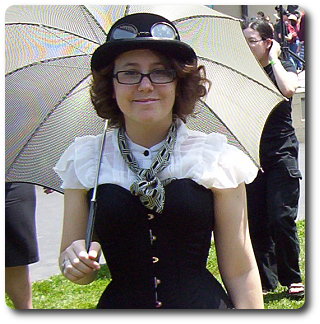
About the Reviewer:
Lady Almira Inchcombe is presently serving on the all-female crew of the H.M.S. Chronabelle, an airship docked in the San Francisco Bay Area. She is acting Weapons Specialist, Event Planner, and Book Enthusiast. A couple of years ago, she became interested in this strange thing called ‘steampunk’ and the rest is history. In her spare time, she goes by the pseudonym of Tessa, and masquerades as a student.
About Author
 Lady Almira