Jump to Navigation

Science

Cliff's Wimshurst Machine

Cliff writes:

Thanx for the information and plans. I built this out of salvaged parts from work and purchased lamp finds, the wood pulleys and parts were turned by me. The guys I work with love it. By the way I work at a power plant.

Nothing makes me happier then hearing that I've inspired someone to make something, and when the result is as beautiful as Cliff's Wimshurst? Shear joy!  - Jake.

More images after the cut . . . 


Jigsaw and Science

limelight!

This St Patrick's Day, Jigsaw held a fundraiser for the space called St Maker‘s Day. We planned on maklng potato clocks. Because, you know, lt‘s an Irlsh holiday, and we all know the Irish looove thelr potatoes (I'm Irlsh, so I guess that means I can say these things). It was my task to obtain the things with which to make them. I dug around in the local electronics store for alligator clips and wire. I dallied at the hardware store getting galvanized nails. However, I failed with the two obvious componants of 1) Potatoes and 2) Clocks. So we did what any good makerspace would do and improvised.
 
What else could we measure the voltage of? Anythlng, really, but how about limes? Those are green, the stereotypical color of the day, and readily available at the Hideout around the corner. Nick persuaded the bartender to hand over a total of 4. We had a control llme, a boiled lime, a nuked lime, and a frozen lime. Over tlme, the frozen lime underwent another reactlon and became the thawed lime. You can flnd the readings on our blog, but the most important thing was that if you wlre the limes ln series you can power an LED. Giving you a limelight. (Oh yes, I love the puns). We also calculated that to power an iPad, you couldn't use llmes because lt's an Apple product.
 
[Jigsaw Renaissance is a Seattle based makerspace that I've been a member of since it's inception. If you live in the greater Seattle area you should definitely check it out! - Jake]

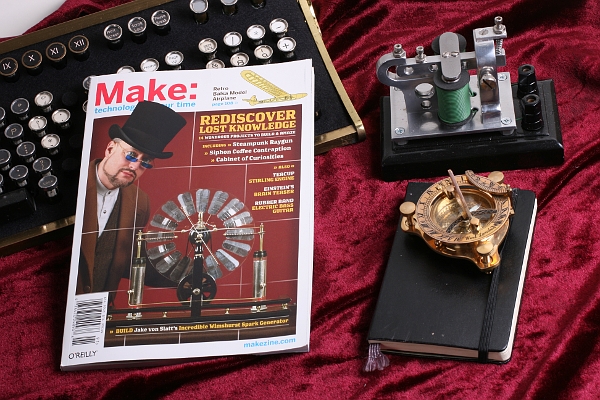
Make: Magazine - Build a Wimshurst Influence Machine

Look what I found in my mailbox today!

Sometime during Maker Faire last year Gareth Branwyn mentioned to me that he would be editing a "Lost Knowledge" issue of Make: Magazine and that I should consider writing an article. Of course, I immediately replied: "Dude! count me in!"

UPDATE: Plans for my Wimshurst Machine are now available here!

Instruments for Natural Philosophy

Long before I got into Steampunk, in fact long before that name had been coined, I had a love for scientific instruments.

I would rescue the catalogues of instruments and demonstrations from the dumpster behind our school at the end of each year when the science teachers would discard them and take them home to pour over like the Sears xmas Wishbook (or maybe the lingerie supplement ;-) )!

Here's a marvellous resource for the Steampunk fabricator, with hundreds and hundreds of pictures of vintage scientific instruments organized by area of investigation. It's a place I often look to for inspiration.

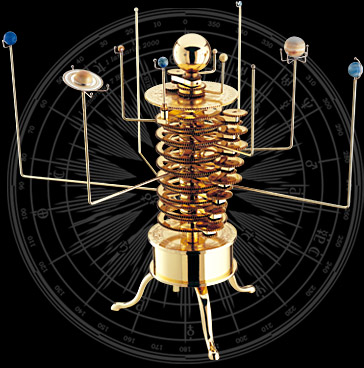
Orrery (kit?) from Japan

I am not quite sure what is going on here, but as near as I can tell this is an offer for a beautiful brass orrery kit. An orrery is a mechanical simulacrum of the Solar System with clockwork designed such that the planets of the orrery move in the same relation to each other as the actual planets do in the Solar System

It appears from the google translated page that you will receive a different kit of parts each week until your orrery is complete.

It seems to me that we used to have kits like this here but they faded and disappeared sometime in the last twenty or so years, pity that.


[Thanks Jellyfish!]

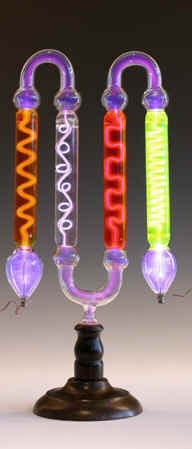
Geissler Tubes

Geissler tubes were made primarily at the end of the 19th century and into the 20th as curiosities. They came in a great variety of sizes, shapes, and colors.

From Wikipedia:

Geissler tubes were mass produced from the 1880s as entertainment devices, with various spherical chambers and decorative serpentine paths formed into the glass tube. When the tube was handled (the terminals were insulated) the shape of the plasma changed. Some tubes were very elaborate and complex in shape and would contain chambers within an outer casing. If these were spun at high speed a visual disk of color was seen due to persistence of vision. (Somewhat similar devices in the form of stationary globes are now produced and sold for personal amusement.) As an educational tool they are also used to demonstrate the movement of electrons and the principles of a vacuum.

Mike Harrison has some lovely examples here as well as an incredible amount of other fascinating things on his site like this sinister and creepy mercury arc rectifier!

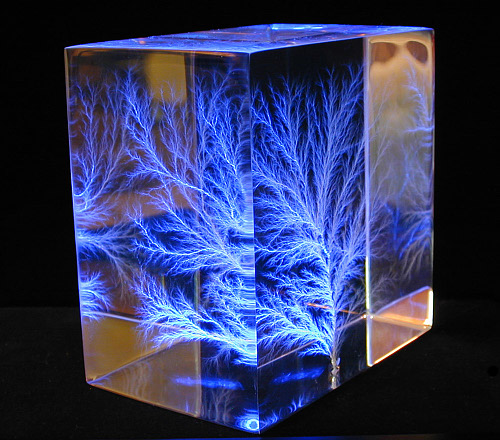
Captured Lightning Scuplture - Lichtenberg Figures

Stoneridge Engineering creates these Lichtenberg figures by using a particle accelerator to create a charge cloud inside of a highly insulating block of acrylic and then discharging that cloud by poking it with what is essential a nail in a board connected to ground. 

This grounding probe causes the substantial charge that's within the block to vaporize the plastic along it's path and creates these beautiful images in the process.

There a video of this discharge process here and you can buy your very own Lichtenberg Figures here!

Captain Nemo's Telescope

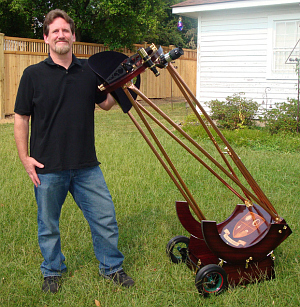
Most of the things that I make, with the possible exception of the Wimshurst Machine I recently completed for an article in Make: Magazine, best fit under the category of "prop" rather than "instrument."  That is clearly not the case for this telescope as it is surely as capable an instrument of science as it is a true beauty!

Ross writes:

I've always found your website an inspiration.  Here is one of the products of that inspiration: a large steampunk-style reflecting telescope in mahogany, brass, and copper.  The telescope won awards in craftsmanship and in mechanical design at last summer's Stellafane conference in Vermont, the world mecca for amateur astronomy.

I have more pictures (at full scale) at:
http://www.flickr.com/photos/8315630@N04/

The Stellafane site has a few more pictures, about half-way down the page:
http://stellafane.org/convention/2008/2008scopes.html

Best,
Ross Sackett, Ph.D.

 One more gorgeous shot under the cut and the rest at Ross' Flicker! Thanks Ross!

Ada Lovelace Day - Woman in Technology

"I will publish a blog post on Tuesday 24th March about a woman in technology whom I admire but only if 1,000 other people will do the same." — Suw Charman-Anderson

Ada Lovelace Day is an international day of blogging to draw attention to women excelling in technology. Women's contributions often go unacknowledged, their innovations seldom mentioned, their faces rarely recognised. We want you to tell the world about these unsung heroines. Whatever she does, whether she is a sysadmin or a tech entrepreneur, a programmer or a designer, developing software or hardware, a tech journalist or a tech consultant, we want to celebrate her achievements.

I'm in! Join me!


Articles:
Subscribe to RSS - Science